I’ve updated my [metricsgraphics](https://github.com/hrbrmstr/metricsgraphics) package to version [0.7](https://github.com/hrbrmstr/metricsgraphics/releases/tag/v0.7). The core [MetricsGraphics](http://metricsgraphicsjs.org) JavaScript library has been updated to version 2.1.0 (from 1.1.0). Two blog-worthy features since releasing version 0.5 are `mjs_grid` (which is a `grid.arrange`-like equivalent for `metricsgraphics` plots and `mjs_add_rollover` which lets you add your own custom rollover text to the plots.
### The Grid
The `grid.arrange` (and `arrangeGrob`) functions from the `gridExtra` package come in handy when combining `ggplot2` charts. I wanted a similar way to arrange independent or linked `metricsgraphics` charts, hence `mjs_grid` was born.
`mjs_grid` uses the tag functions in `htmltools` to arrange `metricsgraphics` plot objects into an HTML `

| Variable | Columns | Type |
|---|---|---|
| COOP ID | 1-6 | Character |
| YEAR | 7-10 | Integer |
| MONTH | 11-12 | Integer |
| ELEMENT | 13-16 | Character |
| VALUE1 | 17-21 | Integer |
| MFLAG1 | 22 | Character |
| QFLAG1 | 23 | Character |
| SFLAG1 | 24 | Character |
| VALUE2 | 25-29 | Integer |
| MFLAG2 | 30 | Character |
| QFLAG2 | 31 | Character |
| SFLAG2 | 32 | Character |
| … | … | … |
| VALUE31 | 257-261 | Integer |
| MFLAG31 | 262 | Character |
| QFLAG31 | 263 | Character |
| SFLAG31 | 264 | Character |
We have fixed-width, wide-format records with 31 days for each month, which proves the existence of truly insidious people in the world. Rather than use `read.fwf` again, we’ll take a different approach (since we ultimately need the data in long format) and use `readLines` to read in all the records from the NH data file, then filter out everything but snowfall entries from the station we’re interested in.
Next, we setup nested `lapply` calls to build a long data frame from each month then combine them all together into a single data frame:
snow <- readLines("data/state27_NH.txt")

snow <- grep("SNOW", snow, value=TRUE)
snow <- grep("^272174", snow, value=TRUE)

snow_dat <- rbindlist(pblapply(snow, function(x) {

  rbindlist(lapply(1:31, function(i) {

    # record format described here:
    # http://cdiac.ornl.gov/ftp/ushcn_daily/data_format.txt

    start <- 17 + (i-1)*8

    list(coop_id=substr(x, 1, 6),
         date=sprintf("%s-%02d-%02d", substr(x, 7, 10), as.numeric(substr(x, 11, 12)), i),
         element=substr(x, 13, 16),
         value=as.numeric(substr(x, start, start+4)),
         mflag=substr(x, start+5, start+5),
         qflag=substr(x, start+6, start+6),
         sflag=substr(x, start+7, start+7))

  }))

}))
Now, we’ll clean up the records even further by removing invalid entries (those with a `value` == `-9999`) and convert record dates to actual `Date` objects and filter out invalid dates:
snow_dat <- snow_dat %>% filter(value != -9999)

# since the data file has 31 days for each records regardless of whether
# that's valid or not we do a shortcut to remove invalid dates by doing the
# a vectorized Date conversion, then removing records with NA dates

snow_dat$date <- as.Date(snow_dat$date)
snow_dat <- snow_dat %>% filter(!is.na(date))

# having the year extracted is handy for filtering
snow_dat$year <- format(snow_dat$date, "%Y")
Given that Winter in the U.S. spans across two calendar years, we need a way to keep dates in January-May associated with the previous year (yes, that adds an inherent assumption that no first snow is in June, which might not hold true for Alaska). To facilitate this, we’ll convert each date to its corresponding day of year value then add the number of total days in the start year to those values for all months <= May. We really do need to do this, too, since there are many cases where the first snowfall will be in January-March for many states.
snow_dat$doy <- as.numeric(format(snow_dat$date, "%j"))
snow_dat$doy <- ifelse(snow_dat$doy<=180,
                       snow_dat$doy + as.numeric(format(as.Date(sprintf("%s-12-31", snow_dat$year)), "%j")),
                       snow_dat$doy)
Now, the fun begins. We use (mostly) `dplyr` to extract the first snowfall day from each year, then make a dot-line plot from the data:
first <- snow_dat %>%
  filter(value>0) %>%                           # ignore 0 values
  filter(date>=as.Date("1950-01-01")) %>%       # start at 1950 (arbitrary)
  merge(stations, by="coop_id", all.x=TRUE) %>% # merge station details
  group_by(coop_id, year) %>%                   # group by station and year
  arrange(doy) %>%                              # sort by our munged day of year
  filter(row_number(doy) == 1) %>%              # grab the first entry by group
  select(name, state, date, value, doy)         # we only need some variables

title_1 <- sprintf("First observed snowfall (historical) at %s, %s", stri_trans_totitle(unique(first$name)), unique(first$state))

gg <- ggplot(first, aes(y=year, x=doy))
gg <- gg + geom_segment(aes(xend=min(first$doy)-20, yend=year), color="#9ecae1", size=0.25)
gg <- gg + geom_point(aes(color=coop_id), shape=8, size=3, color="#3182bd")
gg <- gg + geom_text(aes(label=format(date, "%b-%d")), size=3, hjust=-0.2)
gg <- gg + scale_x_continuous(expand=c(0, 0), limits=c(min(first$doy)-20, max(first$doy)+20))
gg <- gg + labs(x=NULL, y=NULL, title=title_1)
gg <- gg + theme_bw()
gg <- gg + theme(legend.position="none")
gg <- gg + theme(panel.grid=element_blank())
gg <- gg + theme(panel.border=element_blank())
gg <- gg + theme(axis.ticks.x=element_blank())
gg <- gg + theme(axis.ticks.y=element_blank())
gg <- gg + theme(axis.text.x=element_blank())
gg <- gg + theme(axis.text.y=element_text(color="#08306b"))
by_year <- gg
While that will help us see the diversity across years, we have to do quite a bit of eye tracking to get the most likely date range for the first snowfall, so we’ll add a boxplot into the mix and use `summary` to figure out the quartiles (for labeling the chart) for the actual date values:
wx_range <- summary(as.Date(format(first$date, "2013-%m-%d")))
names(wx_range) <- NULL
min_wx <- gsub("2013-", "", wx_range[2])
max_wx <- gsub("2013-", "", wx_range[5])

title_2 <- sprintf("Most likely first snowfall will be between %s & %s", min_wx, max_wx)

gg <- ggplot(first %>% mutate(name="0000"), aes(name, doy))
gg <- gg + geom_boxplot(fill="#3182bd", color="#08306b", outlier.colour="#08306b")
gg <- gg + scale_y_continuous(expand=c(0, 0),
                              limits=c(min(first$doy)-20, max(first$doy)+20))
gg <- gg + coord_flip()
gg <- gg + labs(x=NULL, y=NULL, title=title_2)
gg <- gg + theme_bw()
gg <- gg + theme(legend.position="none")
gg <- gg + theme(panel.grid=element_blank())
gg <- gg + theme(panel.border=element_blank())
gg <- gg + theme(axis.ticks.x=element_blank())
gg <- gg + theme(axis.text.x=element_blank())
gg <- gg + theme(axis.ticks.y=element_line(color="white"))
gg <- gg + theme(axis.text.y=element_text(color="white"))
gg <- gg + theme(plot.title=element_text(size=11))
box_wx <- gg
Finally, we’ll combine them together to get the finished product:
grid.arrange(by_year, box_wx, nrow=2, heights=unit(c(0.9, 0.1), "npc"))

And, do the same for Portland:
 Click for larger
There are many more analyses and visualizations that can be performed on these data sets, but be wary when creating them as I’ve seen a few files with fixed-width formatting errors and have also noticed missing records for some observer stations.
You can find the complete, commented code up on [github](https://github.com/hrbrmstr/snowfirst).
The Washingon Post did another great story+vis, this time on states [Spending seized assets](http://www.washingtonpost.com/wp-srv/special/investigative/asset-seizures/).
According to their sub-head:
>_Since 2008, about 5,400 police agencies have spent $2.5 billion in proceeds from cash and property seized under federal civil forfeiture laws. Police suspected the assets were linked to crime, although in 81 percent of cases no one was indicted._
Their interactive visualization lets you drill down into each state to examine the spending in each category. Since the WaPo team made the [data available](http://www.washingtonpost.com/wp-srv/special/investigative/asset-seizures/data/all.json) [JSON] I thought it might be interesting to take a look at a comparison across states (i.e. who are the “big spenders” of this siezed hoarde). Here’s a snippet of the JSON:
{"states": [
  {
  "st": "AK",
  "stn": "Alaska",
  "total": 8470032,
  "cats":
     [{ "weapons": 1649832,
     "electronicSurv": 402490,
     "infoRewards": 760730,
     "travTrain": 848128,
     "commPrograms": 121664,
     "salaryOvertime": 776766,
     "other": 1487613,
     "commComp": 1288439,
     "buildImprov": 1134370 }],
  "agencies": [
     {
     "aid": "AK0012700",
     "aname": "Airport Police & Fire Ted Stevens Anch Int'L Arpt",
     "total": 611553,
     "cats":
        [{ "weapons": 214296, "travTrain": 44467, "other": 215464, "commComp": 127308, "buildImprov": 10019 }]
     },
     {
     "aid": "AK0010100",
     "aname": "Anchorage Police Department",
     "total": 3961497,
     "cats":
        [{ "weapons": 1104777, "electronicSurv": 94741, "infoRewards": 743230, "travTrain": 409474, "salaryOvertime": 770709, "other": 395317, "commComp": 249220, "buildImprov": 194029 }]
     },
Getting the data was easy (in R, of course!). Let’s setup the packages we’ll need:
library(data.table)
library(dplyr)
library(tidyr)
library(ggplot2)
library(scales)
library(grid)
library(statebins)
library(gridExtra)
We also need `jsonlite`, but only to parse the data (which I’ve downloaded locally), so we’ll just do that in one standalone line:
data <- jsonlite::fromJSON("all.json", simplifyVector=FALSE)
It’s not fair (or valid) to just compare totals since some states have a larger population than others, so we’ll show the data twice, once in raw totals and once with a per-capita lens. For that, we’ll need population data:
pop <- read.csv("http://www.census.gov/popest/data/state/asrh/2013/files/SCPRC-EST2013-18+POP-RES.csv", stringsAsFactors=FALSE)
colnames(pop) <- c("sumlev", "region", "divison", "state", "stn", "pop2013", "pop18p2013", "pcntest18p")
pop$stn <- gsub(" of ", " Of ", pop$stn)
We have to fix the `District of Columbia` since the WaPo data capitalizes the `Of`.
Now we need to extract the agency data. This is really straightforward with some help from the `data.table` package:
agencies <- rbindlist(lapply(data$states, function(x) {
  rbindlist(lapply(x$agencies, function(y) {
    data.table(st=x$st, stn=x$stn, aid=y$aid, aname=y$aname, rbindlist(y$cats))
  }), fill=TRUE)
}), fill=TRUE)
The `rbindlist` `fill` option is super-handy in the event we have varying columns (and, we do in this case). It’s also wicked-fast.
Now, we use some `dplyr` and `tidyr` to integrate the population information and summarize our data (OK, we cheat and use `melt`, but some habits are hard to break):
c_st <- agencies %>%
  merge(pop[,5:6], all.x=TRUE, by="stn") %>%
  gather(category, value, -st, -stn, -pop2013, -aid, -aname) %>%
  group_by(st, category, pop2013) %>%
  summarise(total=sum(value, na.rm=TRUE), per_capita=sum(value, na.rm=TRUE)/pop2013) %>%
  select(st, category, total, per_capita)
Let’s use a series of bar charts to compare state-against state. We’ll do the initial view with just raw totals. There are 9 charts, so this graphic scrolls a bit and you can select it to make it larger:
# hack to ordering the bars by kohske : http://stackoverflow.com/a/5414445/1457051 #####

c_st <- transform(c_st, category2=factor(paste(st, category)))
c_st <- transform(c_st, category2=reorder(category2, rank(-total)))

# pretty names #####

levels(c_st$category) <- c("Weapons", "Travel, training", "Other",
                           "Communications, computers", "Building improvements",
                           "Electronic surveillance", "Information, rewards",
                           "Salary, overtime", "Community programs")
gg <- ggplot(c_st, aes(x=category2, y=total))
gg <- gg + geom_bar(stat="identity", aes(fill=category))
gg <- gg + scale_y_continuous(labels=dollar)
gg <- gg + scale_x_discrete(labels=c_st$st, breaks=c_st$category2)
gg <- gg + facet_wrap(~category, scales = "free", ncol=1)
gg <- gg + labs(x="", y="")
gg <- gg + theme_bw()
gg <- gg + theme(strip.background=element_blank())
gg <- gg + theme(strip.text=element_text(size=15, face="bold"))
gg <- gg + theme(panel.margin=unit(2, "lines"))
gg <- gg + theme(panel.border=element_blank())
gg <- gg + theme(legend.position="none")
gg
Comparison of Spending Category by State (raw totals)

There are definitely a few, repeating “big spenders” in that view, but is that the _real_ story? Let’s take another look, but factoring in state population:
# change bar order to match per-capita calcuation #####

c_st <- transform(c_st, category2=reorder(category2, rank(-per_capita)))

# per-capita bar plot #####

gg <- ggplot(c_st, aes(x=category2, y=per_capita))
gg <- gg + geom_bar(stat="identity", aes(fill=category))
gg <- gg + scale_y_continuous(labels=dollar)
gg <- gg + scale_x_discrete(labels=c_st$st, breaks=c_st$category2)
gg <- gg + facet_wrap(~category, scales = "free", ncol=1)
gg <- gg + labs(x="", y="")
gg <- gg + theme_bw()
gg <- gg + theme(strip.background=element_blank())
gg <- gg + theme(strip.text=element_text(size=15, face="bold"))
gg <- gg + theme(panel.margin=unit(2, "lines"))
gg <- gg + theme(panel.border=element_blank())
gg <- gg + theme(legend.position="none")
gg
Comparison of Spending Category by State (per-capita)

That certainly changes things! Alaska, West Virginia, and D.C. definitely stand out for “Weapons”, “Other” & “Information”, respectively, (what’s Rhode Island hiding in “Other”?!) and the “top 10” in each category are very different from the raw total’s view. We can look at this per-capita view with the `statebins` package as well:
st_pl <- vector("list", 1+length(unique(c_st$category)))

j <- 0
for (i in unique(c_st$category)) {
  j <- j + 1
  st_pl[[j]] <- statebins_continuous(c_st[category==i,], state_col="st", value_col="per_capita") +
    scale_fill_gradientn(labels=dollar, colours=brewer.pal(6, "PuBu"), name=i) +
    theme(legend.key.width=unit(2, "cm"))
}
st_pl[[1+length(unique(c_st$category))]] <- list(ncol=1)

grid.arrange(st_pl[[1]], st_pl[[2]], st_pl[[3]],
             st_pl[[4]], st_pl[[5]], st_pl[[6]],
             st_pl[[7]], st_pl[[8]], st_pl[[9]], ncol=3)
Per-capita “Statebins” view of WaPo Seizure Data
(Doing this exercise also showed me I need to add some flexibility to the `statebins` package).
The (https://gist.github.com/hrbrmstr/27b8f44f573539dc2971) shows how to build a top-level category data table (along with the rest of the code in this post). I may spin this data up into an interactive D3 visualization in the next week or two (as I think it might work better than large faceted bar charts), so stay tuned!
A huge thank you to the WaPo team for making data available to others. Go forth and poke at it with your own questions and see what you can come up with (perhaps comparing by area of state)!
Markus Gessman (@MarkusGesmann) did a beautiful job [Visualising the seasonality of Atlantic windstorms](http://www.magesblog.com/2014/10/visualising-seasonality-of-atlantic.html) using small multiples, which was inspired by both a [post](http://freakonometrics.hypotheses.org/17113) by Arthur Charpentier (@freakonometrics) on using Markov spatial processes to “generate” hurricanes—which was [tweaked a bit](http://robertgrantstats.wordpress.com/2014/10/01/transparent-hurricane-paths-in-r/) by Robert Grant (@robertstats)—and [Gaston Sanchez](https://github.com/gastonstat)’s [Visualizing Hurricane Trajectories](http://rpubs.com/gaston/hurricanes) RPub.
I have [some history](http://rud.is/b/2012/10/28/watch-sandy-in-r-including-forecast-cone/) with hurricane data and thought I’d jump on the bandwagon using the same data and making some stop-frame animations. I borrowed from previous work (hence starting with all the credits above) but have used `dplyr` idioms for data-frame filtering & mutating and my own month/year extraction code.
The first animation accumulates storm tracks in-year and displays the names of the storms in a list down the left side while the second does a full historical accumulation of tracks. I changed the storm path gradient but kept most of the other formatting bits and made the plots suitable for 1080p output/playback.
Rather than go the `ffmpeg` route, I used [ImageMagick](http://www.imagemagick.org/) since it makes equally quick work out of converting a bunch of `png` files to an `mp4` file. I made the animations go quickly, but they can be advanced forward/back one frame at a time in any decent player.
library(maps)
library(data.table)
library(dplyr)
library(ggplot2)
library(grid)
library(RColorBrewer)

# takes in a numeric vector and returns a sequence from low to high
rangeseq <- function(x, by=1) {
  rng <- range(x)
  seq(from=rng[1], to=rng[2], by=by)
}

# etract the months (as a factor of full month names) from
# a date+time "x" that can be converted to a POSIXct object,
extractMonth <- function(x) {
  months <- format(as.POSIXct(x), "%m")
  factor(months, labels=month.name[rangeseq(as.numeric(months))])
}

# etract the years (as a factor of full 4-charater-digit years) from
# a date+time "x" that can be converted to a POSIXct object,
extractYear <- function(x) {
  factor(as.numeric(format(as.POSIXct(x), "%Y")))
}

# get from: ftp://eclipse.ncdc.noaa.gov/pub/ibtracs/v03r06/all/csv/Allstorms.ibtracs_all.v03r06.csv.gz
storms_file <- "data/Allstorms.ibtracs_all.v03r06.csv"
storms <-  fread(storms_file, skip=10, select=1:18)

col_names <- c("Season", "Num", "Basin", "Sub_basin", "Name", "ISO_time", "Nature",
             "Latitude", "Longitude", "Wind.kt", "Pressure.mb", "Degrees_North", "Deegrees_East")
setnames(storms, paste0("V", c(2:12, 17, 18)), col_names)

# use dplyr idioms to filter & mutate the data

storms <- storms %>%
  filter(Latitude > -999,                                  # remove missing data
         Longitude > -999,
         Wind.kt > 0,
         !(Name %in% c("UNNAMED", "NONAME:UNNAMED"))) %>%
  mutate(Basin=gsub(" ", "", Basin),                       # clean up fields
         ID=paste(Name, Season, sep="."),
         Month=extractMonth(ISO_time),
         Year=extractYear(ISO_time)) %>%
  filter(Season >= 1989, Basin %in% "NA")                  # limit to North Atlantic basin

season_range <- paste(range(storms$Season), collapse=" - ")
knots_range <- range(storms$Wind.kt)

# setup base plotting parameters (these won't change)

base <- ggplot()
base <- base + geom_polygon(data=map_data("world"),
                            aes(x=long, y=lat, group=group),
                            fill="gray25", colour="gray25", size=0.2)
base <- base + scale_color_gradientn(colours=rev(brewer.pal(n=9, name="RdBu")),
                                     space="Lab", limits=knots_range)
base <- base + xlim(-138, -20) + ylim(3, 55)
base <- base + coord_map()
base <- base + labs(x=NULL, y=NULL, title=NULL, colour = "Wind (knots)")
base <- base + theme_bw()
base <- base + theme(text=element_text(family="Arial", face="plain", size=rel(5)),
                     panel.background = element_rect(fill = "gray10", colour = "gray30"),
                     panel.margin = unit(c(0,0), "lines"),
                     panel.grid.major = element_blank(),
                     panel.grid.minor = element_blank(),
                     plot.margin = unit(c(0,0,0,0), "lines"),
                     axis.text.x = element_blank(),
                     axis.text.y = element_blank(),
                     axis.ticks = element_blank(),
                     legend.position = c(0.25, 0.1),
                     legend.background = element_rect(fill="gray10", color="gray10"),
                     legend.text = element_text(color="white", size=rel(2)),
                     legend.title = element_text(color="white", size=rel(5)),
                     legend.direction = "horizontal")

# loop over each year, producing plot files that accumulate tracks over each month

for (year in unique(storms$Year)) {

  storm_ids <- unique(storms[storms$Year==year,]$ID)

  for (i in 1:length(storm_ids)) {

    storms_yr <- storms %>% filter(Year==year, ID %in% storm_ids[1:i])

    # stuff takes a while, so it's good to have a progress message
    message(sprintf("%s %s", year, storm_ids[i]))

    gg <- base
    gg <- gg + geom_path(data=storms_yr,
                         aes(x=Longitude, y=Latitude, group=ID, colour=Wind.kt),
                         size=1.0, alpha=1/4)
    gg <- gg + geom_text(label=year, aes(x=-135, y=51), size=rel(6), color="white", vjust=1)
    gg <- gg + geom_text(label=paste(gsub(".[[:digit:]]+$", "", storm_ids[1:i]), collapse="\n"),
                         aes(x=-135, y=49.5), size=rel(4.5), color="white", vjust=1)

    # change "quartz" to "cairo" if you're not on OS X

    png(filename=sprintf("output/%s%03d.png", year, i),
        width=1920, height=1080, type="quartz", bg="gray25")
    print(gg)
    dev.off()

  }

}

# convert to mp4 animation - needs imagemagick
system("convert -delay 8 output/*png output/hurr-1.mp4")
# unlink("output/*png") # do this after verifying convert works
# take an alternate approach for accumulating the entire hurricane history
# start with the base, but add to the ggplot object in a loop, which will
# accumulate all the tracks.

gg <- base

for (year in unique(storms$Year)) {

  storm_ids <- unique(storms[storms$Year==year,]$ID)

  for (i in 1:length(storm_ids)) {

    storms_yr <- storms %>% filter(ID %in% storm_ids[i])

    message(sprintf("%s %s", year, storm_ids[i]))
    gg <- gg + geom_path(data=storms_yr,
                         aes(x=Longitude, y=Latitude, group=ID, colour=Wind.kt),
                         size=1.0, alpha=1/4)

    png(filename=sprintf("output/%s%03d.png", year, i),
        width=1920, height=1080, type="quartz", bg="gray25")
    print(gg)
    dev.off()

  }

}

system("convert -delay 8 output/*png output/hurr-2.mp4")
# unlink("output/*png") # do this after verifying convert works
Full code in [this gist](https://gist.github.com/hrbrmstr/23bf06784e898871dd61).
The arrival of the autumnal equinox foreshadows the reality of longer nights and shorter days here in the northeast US. We can both see that reality and distract ourselves from it at the same time by firing up RStudio (or your favorite editor) and taking a look at the sunrise & sunset times based on our map coordinates using some functions from the R {maptools} package.
The sunriset function takes in a lat/lon pair, a range of dates and whether we want sunrise or sunset calculated and returns when those ephemeral events occur. For example, we can see the sunrise time for Portsmouth, NH on Christmas day this year (2014) via:
library(maptools)

# these functions need the lat/lon in an unusual format
portsmouth <- matrix(c(-70.762553, 43.071755), nrow=1)
for_date <- as.POSIXct("2014-12-25", tz="America/New_York")
sunriset(portsmouth, for_date, direction="sunrise", POSIXct.out=TRUE)

##         day_frac                time
## newlon 0.3007444 2014-12-25 07:13:04
We can pass in a vector of dates, to this function, and that means we’ll have data points we can work with to visualize this change. Let’s wrap the sequence generation into a function of our own and extract:
- sunrise
- sunset
- solar noon
- # hours of daylight
for every day in the sequence, returning the result as a data frame.
# adapted from http://r.789695.n4.nabble.com/maptools-sunrise-sunset-function-td874148.html
ephemeris <- function(lat, lon, date, span=1, tz="UTC") {

  # convert to the format we need
  lon.lat <- matrix(c(lon, lat), nrow=1)

  # make our sequence - using noon gets us around daylight saving time issues
  day <- as.POSIXct(date, tz=tz)
  sequence <- seq(from=day, length.out=span , by="days")

  # get our data
  sunrise <- sunriset(lon.lat, sequence, direction="sunrise", POSIXct.out=TRUE)
  sunset <- sunriset(lon.lat, sequence, direction="sunset", POSIXct.out=TRUE)
  solar_noon <- solarnoon(lon.lat, sequence, POSIXct.out=TRUE)

  # build a data frame from the vectors
  data.frame(date=as.Date(sunrise$time),
             sunrise=as.numeric(format(sunrise$time, "%H%M")),
             solarnoon=as.numeric(format(solar_noon$time, "%H%M")),
             sunset=as.numeric(format(sunset$time, "%H%M")),
             day_length=as.numeric(sunset$time-sunrise$time))

}
Now we can take a look at these values over 10 days near All Hallows Eve:
ephemeris(43.071755, -70.762553, "2014-10-31", 10, tz="America/New_York")

##          date sunrise solarnoon sunset day_length
## 1  2014-10-31     716      1226   1736  10.332477
## 2  2014-11-01     717      1226   1734  10.289145
## 3  2014-11-02     518      1026   1533  10.246169
## 4  2014-11-03     620      1126   1632  10.203563
## 5  2014-11-04     621      1126   1631  10.161346
## 6  2014-11-05     622      1126   1629  10.119535
## 7  2014-11-06     624      1126   1628  10.078148
## 8  2014-11-07     625      1126   1627  10.037204
## 9  2014-11-08     626      1126   1626   9.996721
## 10 2014-11-09     627      1126   1625   9.956719
We now have everything we need to visualize the seasonal daylight changes. We’ll use ggplot (with some help from the grid package) and build a two panel graph, one that gives us a “ribbon” view of what hours of the day are in daylight and the other just showing the changes in the total number of hours of daylight available during the day. We’ll build the function so that it will:
- optionally show the current date/time (
TRUEby default) - optionally show when solar noon is (
FALSEby default) - optionally plot the graphs (
TRUEby default) - return an
arrangeGrobof the charts in the event we want to use them in other charts
library(ggplot2)
library(scales)
library(gridExtra)

# create two formatter functions for the x-axis display

# for graph #1 y-axis
time_format <- function(hrmn) substr(sprintf("%04d", hrmn),1,2)

# for graph #2 y-axis
pad5 <- function(num) sprintf("%2d", num)

daylight <- function(lat, lon, place, start_date, span=2, tz="UTC",
                     show_solar_noon=FALSE, show_now=TRUE, plot=TRUE) {

  stopifnot(span>=2) # really doesn't make much sense to plot 1 value

  srss <- ephemeris(lat, lon, start_date, span, tz)

  x_label = ""

  gg <- ggplot(srss, aes(x=date))
  gg <- gg + geom_ribbon(aes(ymin=sunrise, ymax=sunset), fill="#ffeda0")

  if (show_solar_noon) gg <- gg + geom_line(aes(y=solarnoon), color="#fd8d3c")

  if (show_now) {
    gg <- gg + geom_vline(xintercept=as.numeric(as.Date(Sys.time())), color="#800026", linetype="longdash", size=0.25)
    gg <- gg + geom_hline(yintercept=as.numeric(format(Sys.time(), "%H%M")), color="#800026", linetype="longdash", size=0.25)
    x_label = sprintf("Current Date / Time: %s", format(Sys.time(), "%Y-%m-%d / %H:%M"))
  }

  gg <- gg + scale_x_date(expand=c(0,0), labels=date_format("%b '%y"))
  gg <- gg + scale_y_continuous(labels=time_format, limits=c(0,2400), breaks=seq(0, 2400, 200), expand=c(0,0))
  gg <- gg + labs(x=x_label, y="",
                  title=sprintf("Sunrise/set for %s\n%s ", place, paste0(range(srss$date), sep=" ", collapse="to ")))
  gg <- gg + theme_bw()
  gg <- gg + theme(panel.background=element_rect(fill="#525252"))
  gg <- gg + theme(panel.grid=element_blank())

  gg1 <- ggplot(srss, aes(x=date, y=day_length))
  gg1 <- gg1 + geom_area(fill="#ffeda0")
  gg1 <- gg1 + geom_line(color="#525252")

  if (show_now) gg1 <- gg1 + geom_vline(xintercept=as.numeric(as.Date(Sys.time())), color="#800026", linetype="longdash", size=0.25)

  gg1 <- gg1 + scale_x_date(expand=c(0,0), labels=date_format("%b '%y"))
  gg1 <- gg1 + scale_y_continuous(labels=pad5, limits=c(0,24), expand=c(0,0))
  gg1 <- gg1 + labs(x="", y="", title="Day(light) Length (hrs)")
  gg1 <- gg1 + theme_bw()

  if (plot) grid.arrange(gg, gg1, nrow=2)

  arrangeGrob(gg, gg1, nrow=2)

}
We can test our our new function using the same location and graph the sunlight data for a year starting September 1, 2014 (select graph for full-size version):
daylight(43.071755, -70.762553, "Portsmouth, NH", "2014-09-01", 365, tz="America/New_York")

With the longer nights approaching we can further enhance the plotting function to add markers for solstices and perhaps even make a new version that compares sunlight across different geographical locations.
Complete code example is in this gist.
The BBC did a pretty good job [live tracking the Scotland secession vote](http://www.bbc.com/news/events/scotland-decides/results), but I really didn’t like the color scheme they chose and decided to use the final tally site as the basis for another tutorial using the tools from the Hadleyverse and taking advantage of the fact that newer `gdal` libraries can read in [TopoJSON](https://github.com/mbostock/topojson)/GeoJSON files, meaning we can use _most_ of the maps the D3-ers create/use right in R.
We’ll need a few R packages to help us get, clean, format and chart the data:
library(rvest)
library(dplyr)
library(httr) # >0.5
library(tidyr)
library(gpclib)
library(rgeos)
library(sp)
library(maptools)
library(rgdal) # needs gdal > 1.11.0
library(ggplot2)
library(reshape2)
library(gridExtra)
The new `rvest` package makes it super-fun (and easy) to get data out of web pages (as I’ve [mentioned on the sister blog](http://datadrivensecurity.info/blog/posts/2014/Sep/migrating-to-rvest/)), but said data is still web page data, usually geared towards making things render well in a browser, and we end up having to clean up the extracted fields to get useful data. Since we usually want a data frame from the extraction, an `rvest` idiom I’ve been playing with involves bundling the element extraction & cleanup code into one function and then using that to build the columns:
# extract data from rvest-ed <div>'s and clean it up a bit
# pass in the rvested HTML object and the CSS selector to extract, also
# indicating whether we want a number or character vector returned

extractAndCleanup <- function(data, selector, make_numeric=FALSE) {
  x <- data %>% html_nodes(selector) %>% html_text()
  x <- gsub("^[[:punct:][:space:]]*|[[:punct:][:space:]]*$", "", x)
  if (make_numeric) x <- as.numeric(gsub("[,[:space:]]*", "", x))
  x
}

bbc_vote <- html("http://www.bbc.com/news/events/scotland-decides/results")

secede <- data.frame(
  council=bbc_vote %>% extractAndCleanup(".body-row__cell--council"),
  electorate=bbc_vote %>% extractAndCleanup(".body-row__cell--electorate", TRUE),
  yes=bbc_vote %>% extractAndCleanup(".body-row__cell--yes", TRUE),
  no=bbc_vote %>% extractAndCleanup(".body-row__cell--no", TRUE),
  stringsAsFactors=FALSE)
We can then compute whether the vote tally was to secede or not and assign a color in the event we choose to use base graphics for plotting (we won’t for this tutorial). I chose a muted version of the Union Jack red and the official Scottish blue for this exercise.
secede <- secede %>% mutate(gone=yes>no,
                            color=ifelse(gone, "#0065BD", "#CF142B77"))
Getting the map from the BBC site is just as simple. An inspection of the site in any decent browser with a “Developer” mode lets us see the elements being downloaded. For the BBC map, it reads the data from: `http://static.bbci.co.uk/news/1.49.0-1192/js/data/maps/l/scotland-elections.js` which is a TopoJSON object wrapped in two lines of extra javascript code. We’ll grab that file, clean it up and read the map into R using `httr`’s new-ish ability to save to a data file:
GET("http://static.bbci.co.uk/news/1.49.0-1192/js/data/maps/l/scotland-elections.js",
    write_disk("data/scotland.json"), progress())
tmp <- readLines("data/scotland.json")
dir.create("data")
writeLines(tmp[2], "data/scotland.json")

map <- readOGR("data/scotland.json", "scotland-elections")
We’ll want to work with the map using Council names, so we need to ensure the names from the extracted `div` elements match what’s in the TopoJSON file:
secede$council %in% map@data$name

##  [1]  TRUE  TRUE  TRUE FALSE  TRUE FALSE FALSE  TRUE  TRUE  TRUE  TRUE  TRUE
## [13] FALSE  TRUE  TRUE FALSE  TRUE  TRUE  TRUE  TRUE  TRUE  TRUE  TRUE FALSE
## [25]  TRUE  TRUE  TRUE  TRUE  TRUE  TRUE  TRUE  TRUE
It looks like we’ll need to clean the names up a bit, but thankfully the names aren’t too far off:
secede$council <- gsub("&", "and", secede$council)
secede[secede$council=="Edinburgh",]$council = "City of Edinburgh"
secede[secede$council=="Glasgow",]$council = "Glasgow City"
secede[secede$council=="Comhairle nan Eilean Siar",]$council = "Na h-Eileanan an Iar"
If we were using base graphics for plotting, we’d also have to ensure the data was in the right order:
secede$council <- factor(secede$council, map@data$name, ordered=TRUE)
secede <- secede %>% arrange(council)
We’re going to use `ggplot` for the mapping portion, but the normal `fortify` process didn’t work on this TopoJSON file (some polygon errors emerged), so we’ll take another route and do the data Council name↔id mapping after the `fortify` call and merge the rest of our data into the map data frame:
map_df <- fortify(map)

# manually associate the map id's with the Council names and vote data
councils <- data.frame(id=0:(length(map@data$name)-1),
                       council=as.character(map@data$name))
map_df <- merge(map_df, councils, by="id")
map_df <- merge(map_df, secede, by="council")
Now we can generate the choropleth:
gg <- ggplot()
gg <- gg + geom_map(data=map_df, map=map_df,
                    aes(map_id=id, x=long, y=lat, group=group, fill=color),
                    color="white", size=0.25)
gg <- gg + scale_fill_manual(values=rev(unique(secede$color)),
                             labels=c("Yes", "No"), name="Secede?")
gg <- gg + xlim(extendrange(r=range(coordinates(map)[,1]), f=0.15))
gg <- gg + ylim(extendrange(r=range(coordinates(map)[,2]), f=0.07))
gg <- gg + coord_map()
gg <- gg + labs(x="", y="")
gg <- gg + theme_bw()
gg <- gg + theme(panel.grid=element_blank())
gg <- gg + theme(legend.position="none")
gg <- gg + theme(panel.border=element_blank())
gg <- gg + theme(axis.ticks=element_blank())
gg <- gg + theme(axis.text=element_blank())
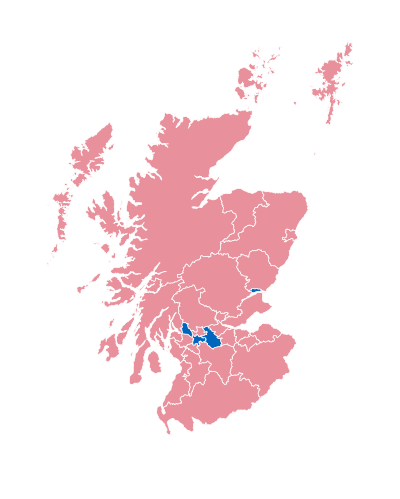
A choropleth is all well-and-good, but—since we have the data–let’s add the bar chart to complete the presentation. We’ll combine some `dplyr` and `tidyr` calls to melt and subset our data frame:
secede_m <- secede %>%
  gather(variable, value, -council) %>%
  filter(variable %in% c("yes", "no")) %>%
  mutate(value=as.numeric(value))
For this exercise, we’ll plot the 100% stacked bars in order of the “No” votes, and we’ll pre-process this ordering to make the `ggplot` code easier on the eyes. We start by merging some data back into our melted data frame so we can build the sorted factor by the “No” value column and then make sure the Councils will be in that order:
secede_m <- merge(secede_m, secede, by="council")
secede_m$variable <- factor(secede_m$variable,
                            levels=c("yes", "no"), ordered=TRUE)
secede_m <- secede_m %>% arrange(no, variable)
secede_m$council <- factor(secede_m$council,
                           unique(secede_m$council), ordered=TRUE)
Finally, we can create the 100% stacked bar plot and combine it with the choropleth to build the final product:
gg1 <- ggplot(secede_m, aes(x=council, y=value, fill=factor(variable)))
gg1 <- gg1 + geom_bar(stat="identity", position="fill")
gg1 <- gg1 + scale_fill_manual(values=rev(unique(secede$color)),
                             labels=c("Yes", "No"), name="Secede?")
gg1 <- gg1 + geom_hline(yintercept=0.50, color="gray80")
gg1 <- gg1 + geom_text(aes(label=percent(yes/100)), y=0.08, color="white", size=3)
gg1 <- gg1 + geom_text(aes(label=percent(no/100)), y=0.92, color="white", size=3)
gg1 <- gg1 + coord_flip()
gg1 <- gg1 + labs(x="", y="")
gg1 <- gg1 + theme_bw()
gg1 <- gg1 + theme(panel.grid=element_blank())
gg1 <- gg1 + theme(legend.position="top")
gg1 <- gg1 + theme(panel.border=element_blank())
gg1 <- gg1 + theme(axis.ticks=element_blank())
gg1 <- gg1 + theme(axis.text.x=element_blank())

vote <- arrangeGrob(gg1, gg, ncol=2,
                     main=textGrob("Scotland Votes", gp=gpar(fontsize=20)))
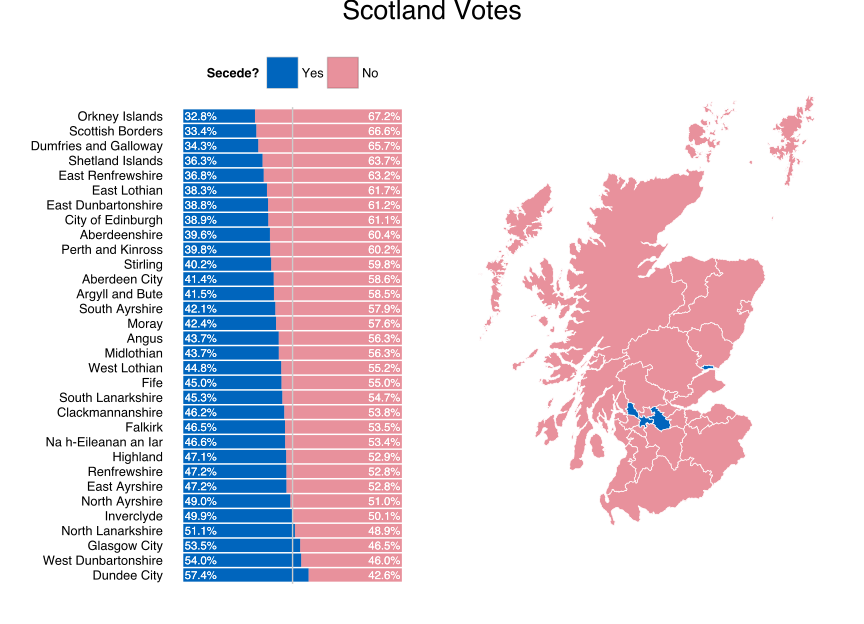
(Click for larger version)
I’ve bundled this code up into it’s own [github repo](https://github.com/hrbrmstr/secede-2014). The full project example has a few extra features as
– it shows how to save the resultant data frame to an R data file (in case the BBC nukes the site)
– also saves the cleaned-up JSON (getting minimal Scotland shapefiles is tricky so this one’s a keeper even with the polygon errors)
– wraps all that in `if` statements so future analysis/vis can work with or without the live data being available.
Hadley really has to stop making R so fun to work with :-)
UPDATE
Based on a comment by Paul Drake suggesting that the BBC choropleth (and, hence, my direct clone of it) could be made more informative by showing the vote difference. Since it’s just changing two lines of code, here it is in-situ vs creating a new post.
gg <- gg + geom_map(data=map_df, map=map_df,
                    aes(map_id=id, x=long, y=lat, group=group, fill=yes-no),
                    color="white", size=0.25)
gg <- gg + scale_fill_gradient(low="#CF142B", high="#0065BD",
                               name="Secede?\n(vote margin)", guide="legend")

