macOS R users who tend to work on the bleeding edge likely noticed some downtime at <mac.r-project.org> this past weekend. Part of the issue was an SSL/TLS certificate expiration situation. Moving forward, we can monitor this with R using the super spiffy {openssl} and {pushoverr} packages whilst also generating a daily report with {rmarkdown} and {DT}.
The Basic Process
The {openssl} package has a handy function --- download_ssl_cert() --- which will, by default, hit a given host on the standard HTTPS port (443/TCP) and grab the site certificate and issuer. We’ll grab the “validity end” field and convert that to a date to use for comparison.
To get the target list of sites to check I used Rapid7’s FDNS data set and a glance at a few certificate transparency logs to put together a current list of “r-project” domains that have been known to have SSL certs. This process could be made more dynamic, but things don’t change that quickly in r-project domain land.
Finally, we use the {DT} package to build a pretty HTML table and the {pushoverr} package to send notifications at normal priority for certs expiring within a week and critical priority for certs that have expired (the package has excellent documentation which will guide you through setting up a Pushover account).
I put this all in a plain R script named r-project-ssl-notify.R that’s then called from a Linux CRON job which runs:
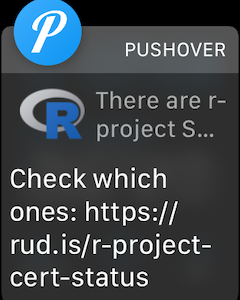
/usr/bin/Rscript -e 'rmarkdown::render(input="PATH_TO/r-project-ssl-notify.R", output_file="PATH_TO/r-project-cert-status/index.html", quiet=TRUE)'once a day at 0930 ET to make this status page and also fire off any notifications which I have going to my watch and phone (I did a test send by expanding the delta to 14 days):

Here’s the contents of
#' ---
#' title: "r-project SSL/TLS Certificate Status"
#' date: "`r format(Sys.time(), '%Y-%m-%d')`"
#' output:
#'   html_document:
#'     keep_md: false
#'     theme: simplex
#'     highlight: monochrome
#' ---
#+ init, include=FALSE
knitr::opts_chunk$set(
  message = FALSE,
  warning = FALSE,
  echo = FALSE,
  collapse=TRUE
)

#+ libs
library(DT)
library(openssl)
library(pushoverr)
library(tidyverse)

# Setup -----------------------------------------------------------------------------------------------------------

# This env config file contains two lines:
#
# PUSHOVER_USER=YOUR_PUSHOVER_USER_STRING
# PUSHOVER_APP=YOUR_PUSHOVER_APP_KEY
#
# See the {pushoverr} package for how to setup your Pushover account
readRenviron("~/jobs/conf/r-project-ssl-notify.env")


# Check certs -----------------------------------------------------------------------------------------------------

# r-project.org domains retrieved from Rapid7's FDNS data set
# (https://opendata.rapid7.com/sonar.fdns_v2/) and cert transparency logs

#+ work
c(
  "beta.r-project.org", "bugs.r-project.org", "cloud.r-project.org",
  "cran-archive.r-project.org", "cran.at.r-project.org", "cran.ch.r-project.org",
  "cran.es.r-project.org", "cran.r-project.org", "cran.uk.r-project.org",
  "cran.us.r-project.org", "developer.r-project.org", "ess.r-project.org",
  "ftp.cran.r-project.org", "journal.r-project.org", "lists.r-forge.r-project.org",
  "mac.r-project.org", "r-project.org", "svn.r-project.org", "translation.r-project.org",
  "user2011.r-project.org", "user2014.r-project.org", "user2016.r-project.org",
  "user2018.r-project.org", "user2019.r-project.org", "user2020.r-project.org",
  "user2020muc.r-project.org", "win-builder.r-project.org", "www.cran.r-project.org",
  "www.r-project.org", "www.user2019.fr"
) -> r_doms

# grab each cert

r_certs <- map(r_doms, openssl::download_ssl_cert)

# make a nice table
tibble(
  dom = r_doms,
  expires = map_chr(r_certs, ~.x[[1]][["validity"]][[2]]) %>% # this gets us the "validity end"
    as.Date(format = "%b %d %H:%M:%S %Y", tz = "GMT"),        # and converts it to a date object
  delta = as.numeric(expires - Sys.Date(), "days")            # this computes the delta from the day this script was called
) %>%
  arrange(expires) -> r_certs_expir

# Status page generation ------------------------------------------------------------------------------------------

# output nice table
DT::datatable(r_certs_expir, list(pageLength = nrow(r_certs_expir))) # if the # of r-proj doms gets too large we'll cap this for pagination

# Notifications ---------------------------------------------------------------------------------------------------

# See if we need to notify abt things expiring within 1 week
# REMOVE THIS or edit the delta max if you want less noise
one_week <- filter(r_certs_expir, between(delta, 1, 7))
if (nrow(one_week) > 0) {
  pushover_normal(
    title = "There are r-project SSL Certs Expiring Within 1 Week",
    message = "Check which ones: https://rud.is/r-project-cert-status"
  )
}

# See if we have expired certs
expired <- filter(r_certs_expir, delta <= 0)
if (nrow(expired) > 0) {
  pushover_critical(
    title = "There are expired r-project SSL Certs!",
    message = "Check which ones: https://rud.is/r-project-cert-status"
  )
}
FIN
With just a tiny bit of R code we have the ability to monitor expiring SSL certs via a diminutive status page and alerts to any/all devices at our disposal.
No comments yet.